
Jean-Philippe Richaud, Deputy CEO and CIO shares his analysis of private markets and his outlook for 2026 , in the latest issue of Grand Angle, Ofi Invest’s biannual publication.
PRIVATE MARKETS LOOKING FOR A SECOND WIND
As we expected, 2025 emphasised the complex nature of today’s private markets: a timid rebound in real estate, still under the pressure of a stock of impaired assets; a lack of natural liquidity in private equity (40% of businesses have been held for more than 5 years, according to Bain & Company); infrastructure taking a toll on allocations; and a private debt market where the restructuring of liquid funds has been put to the test.
The issues at stake are well known and are going to last throughout 2026 for various reasons: the impact of geopolitical crises on supply chains and prices, particularly energy prices; the fragile nature of business plans on account of AI; an ageing population; and investment needs putting pressure on public finances and pushing political organisations to the extremes, to mention just a few of the main sources of concern.
Sovereignty pushing the environment to the sidelines
On top of all this, we have an unexpected conflict to deal with this year. The consequences of the conflict are uncertain, but they include an increasing emphasis on the sovereignty theme among investors’ priorities, putting the decline in the environment theme into even sharper focus. And yet statistical anomalies on the climate in the first half of the year should sound the alarm as loudly as any siren and create just as much shock and awe. Many have registered only the few positive signals to have come out regarding the adjustments made to the IPCC’s scenarios and are dismissing the repeated warnings about feedback loops (warming oceans, melting icecaps, methane emissions, the capacity of forests to capture CO2, etc.).
And yet this is a real emergency. Especially in Europe, where scientists are telling us that climate change is far worse than the global average. This will undoubtedly affect businesses and requires greater efforts as regards selection and support.
Bain & Company stated in its Global Private Equity Report 2026 that demand for capital from General Partners (GPs) was 2.5 times greater than the amount allocated by Limited Partners (LPs). We firmly believe that these themes could offer a welcome second wind, especially when it comes tobringing retail investors on board.
Infrastructure – Central to today’s transitions
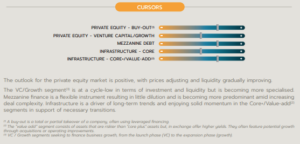
2025 ended with record inflows of over 200 billion euros, driven by a few mega-funds. This is testament to the sheer strength of the sector’s leaders but also to the difficulties that others are encountering to replace their funds. The Core segment has been hit the hardest by macroeconomicdevelopments. At the same time, the number of deals has fallen by around 25% whereas amounts invested have increased by roughly 25%. This also reflects the market’s polarisation.
The situation has continued into 2026, with Europe driving the global momentum, particularly in renewable energies and in energy and digital sovereignty.Growth expected out to 2030 should push infrastructure assets under management up to 3 trillion dollars (Preqin projection in its “Private Markets in 2030” report). The capacity to generate liquidity on favourable terms will be an essential catalyst for such growth.
PrivateEquity – Alpha in support of liquidity
Although conditions are tricky for attracting inflows (-16% for the buyout segment(1) – source Bain & Company), 2025 was a good year for investment and exits alike. Then there is the fact that holding periods are getting longer (7 years on average) while performance dispersion is high. In the venture capital segment, liquidity is an even bigger issue as exits have been falling steadily since 2021; DPI(2) after 5 years is at its lowest level since 1999!In 2026, the market appears to be more favourable for small & mid-market players and those able to really stand out (sectors, complex situations,operational support). Operational excellence, in particular, is becoming essential. The good news is that prices have fallen significantly in the past 5 years andshould once again create opportunities to arbitrate between multiples. The secondary market, providing support in the form of liquidity, will continue to benefit from favourable conditions, especially GP-led transactions(3).
Private debt – a weakening risk/ Reward profile
As a whole, 2025 was a year of consolidation and strategic change for the private debt sector. Inflows were down slightly from 2024 (source Preqin) and the direct lending segment(4) was predominant, but there were growing signs of interest in niche strategies (special situations, distressed funds(5), mezzanine debt(6)).
Looking at 2026, inflows into private debt funds should trend upwards again albeit less so than into PE funds. Mezzanine debt, structurally a moderately-sized market, should maintain its role as a flexible agent and deal facilitator. Such debt is redeemed primarily in equity and rewarded better than senior debt, so it is a useful addition to a private asset allocation strategy.
Did you know ?
« 12 is the new 5 »
This financial expression sums up the current paradigm: if private equity is to continue delivering historical returns (IRR of 20%, multiple of 2.5x), we need to compensatefor higher interest rates by achieving better operating performances.
We now need to generate 12% Ebitda growth, comparedwith 5% when financing terms were more accommodative.
Generating alpha requires support from the IT, HR, finance and strategy departments; it needs more than just the right price at entry.
Discover the full Grand Angle article here.
(1) A buy-out is a total or partial takeover of a company, often using leveraged financing.
(2) DPI is the ratio of distributions to paid-in capital. It is a measure of real liquidity.
(3) GP-led (General Partner-led) transactions are a type of transaction on the secondary private equity market initiated by the GP to create liquidity when a traditional exit is not possible.
(4) The market for funds that finance businesses directly via private debt.
(5) Distressed funds and special situations are two segments of the private equity market that invest in complex or unusual situations, often because a business is struggling or operating in unusual conditions.
(6) Mezzanine debt is subordinated financing that combines features of both debt and equity and that is ranked behind senior debt holders but ahead of shareholders in the event of default.